
A Modern Hero
or: How I Accidentally Became a Superman Apologist


Funny thing is, I used to roll my eyes at Paragon heroes.
Not politely. Not academically. I mean a full-on, arms-crossed, ugh, here we go again sort of dismissal. The kind you get after bingeing too many grimdark shows where everyone broods in the rain, and moral ambiguity is treated like a badge of sophistication.
I even made a YouTube short about it once. Yep. Public record. A tiny little video essay about writing layered protagonists, and somewhere in there, rather smugly, I’ll admit I used paragon heroes as the example of what not to do. Flat characters. Too pure. About as interesting as plain oatmeal.
Luke Skywalker got tossed in there. Superman too.
Luke, nobody seemed terribly concerned about. But Superman? Oh man.
I woke up to a comment section that looked like the philosophical equivalent of someone kicking a hornet’s nest. Paragraphs. Essays. Whole dissertations explaining that Superman isn’t boring despite being a paragon, he’s interesting because of it.
And that stuck with me.
At first I did what anyone does when confronted with a hundred strangers telling them they’re wrong on the internet: I ignored it and moved on with my day.
But it nagged. Quietly. Like a mosquito buzzing somewhere in the room you can’t quite locate.
Eventually, I had to admit something to myself: maybe I’d never actually given Superman a fair shake. Most of the Superman stuff I’d seen growing up was… well. Let’s say uneven. Saturday-morning cartoon interpretations, half-remembered movie clips, cultural osmosis over genuine engagement.
So I told myself I’d dig deeper.
And then I forgot about it entirely for two years.
That happens.
Then my wife and I watched Superman 2025. Mostly on a whim. A quiet evening, nothing better on, the sort of casual decision that usually leads to mediocre popcorn entertainment.
Except… I actually liked it. A lot.
Which sent me down a rabbit hole. Reddit recommendations. Old comic arcs. Eventually, I landed on Superman for All Seasons, which people kept pointing to like it was some sacred text.
And suddenly the whole conversation about paragon heroes felt… different.
So here we are.
Today’s question, the one rattling around in my brain like a loose coin in a dryer drum:
Is empathy the new punk?

1. Moral Absolutes in a World That Loves “It Depends.”
Let’s start with something that makes modern audiences a little uncomfortable.
Superman, at least the one in Superman 2025, is what philosophers would call a moral absolutist.
That sounds academic. But really it just means he believes something simple and radical: some things are just… wrong.
Not complicated, wrong. Not situationally wrong. Just wrong.
Now figuring out the right thing to do that’s the hard part. That’s where the tension in most Superman stories lives. He spends an awful lot of time trying to figure out what action actually helps people.
In the movie, Lois Lane pushes back on this. Early on, the two of them argue about whether Clark has the right to interfere in international conflicts. He’s not a government. Nobody elected him. Who decides what counts as intervention versus domination?
And she has a point.
From that angle, morality becomes relative. If one country claims they’re invading another to “help stabilize the region,” and you disagree well, whose truth wins? Who gets to decide?
Clark’s answer is almost painfully straightforward.
People were getting hurt.
So he helped.
That’s it.
No ten-minute geopolitical monologue. No tortured antihero introspection. Just a quiet conviction that harm happening right in front of you obligates action.
You see the same mindset in Superman for All Seasons, particularly the Fall chapter. Lex Luthor releases a virus across Metropolis, not for profit, not for ideology, but because Superman has stolen the spotlight from him. Petty. Small. Almost embarrassingly childish.
The entire city falls unconscious. Except Lex. And Superman.
Superman is desperate. Panicking, actually. Because for once, his usual toolkit strength, speed, punching problems very hard, does absolutely nothing. You can’t punch a virus.
So he confronts Lex through the window of LexCorp.
Lex claims he has the antidote. But Superman can’t reach it. The building is locked down floor by floor.
Clark says something interesting there. He points out, correctly, that if he simply dragged Lex through the window and forced the issue, someone would arrive with the antidote pretty quickly.
Honestly? Most of us would probably consider that reasonable.
But Superman stops himself.
“I can’t sink to your level.”
It’s a very Kant-like moment, if we’re going to get philosophical about it. Kant argued that moral rules, don’t lie, don’t murder, don’t treat people as tools, should hold regardless of circumstances. Plato had a similar idea: that there exists some pure form of “the Good,” something objective beyond interpretation.
Superman operates inside that framework.
Ends don’t justify means.
Which makes Lex the perfect foil. Later in the story Lex says something that basically summarizes his worldview:
“I learned from my father to give people what they want… for a price.”
That’s moral relativism in a nutshell. Truth shaped by power, perspective, and leverage. Philosophers like Nietzsche leaned into that idea, morality as a human invention rather than a cosmic rulebook. Even earlier, Protagoras famously said “Man is the measure of all things.”
Superman would probably shake his head at that.
And then go save someone.

2. Strength, Apparently, Is Not Screaming at People
Let me pitch you something.
Tired of being a wimp? Want respect? Come to my one-day boot camp where you learn the radical skill of… being a decent human being.
Ridiculous, right?
Except that’s basically the lesson Superman embodies.
In a culture where strength is constantly framed as dominance, bigger voice, bigger ego, bigger fists, Superman’s defining trait is restraint.
Being angry is easy. I know that from experience. Most people do.
Not acting on it? That’s harder.
There’s a passage from Peter Kropotkin’s Mutual Aid that always sticks with me. He dismantles the popular image of the “alpha individual” dominating everyone around them. Instead he argues something almost counterintuitive:
“The strongest individual is not the one who stands alone, but the one who stands with others.”
Strength, in that framework, isn’t domination. It’s cooperation.
And this part gets personal for me.
I grew up around the kind of guy who thought being an “alpha male” meant ruling the house through fear. Big voice. Short temper. The whole thing. My mom, my sister, and I, honestly, we spent a lot of time bracing ourselves for the sound of the front door opening.
That does something to a kid.
For a long time my solution was the opposite extreme. Suppress anger entirely. Bottle it up. Pretend it didn’t exist.
Which, turns out, isn’t healthy either.
That’s where Superman’s version of strength matters. He feels things. Anger, grief, doubt, all of it. But those emotions don’t define how he treats people.
In Superman 2025, Clark learns that the story he believed about why he was sent to Earth might not be true. That shakes him. Deeply.
But he doesn’t implode. He processes it.
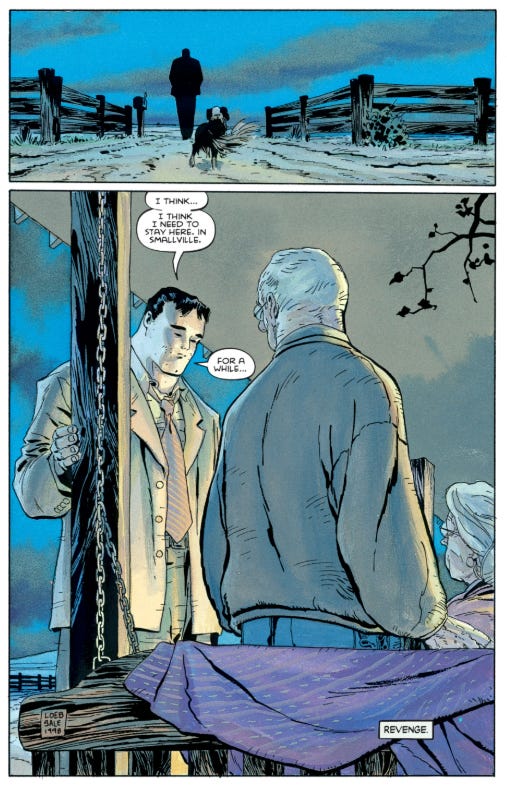
Similarly, in All Seasons, during the Winter chapter, Clark falls into a depression. And instead of lashing out or isolating completely, he works through it.
Which leads to something important.
3. The Most Human Alien
Superman is, famously, an alien.
Right up there with Batman’s parents getting mugged and Uncle Ben catching the world’s worst casserole accident. (Seriously, being a superhero’s relative is basically a death sentence.)
But here’s the strange part.
Despite being the least human person on Earth biologically, Clark Kent often feels like the most human character in the room.
He’s a Kansas farm kid at heart. He gets frustrated. Gets lonely. Gets sad. And then, crucially, he still shows up for people.
Which hits differently in the current moment.
Loneliness is everywhere right now. You don’t need statistics to see it. You can feel it in how people talk online, in how many communities have quietly frayed apart.
Superman, the ultimate outsider, doesn’t respond to that isolation with bitterness.
He responds with compassion.
When Clark feels alone, he leans toward people, not away from them. He builds community. That’s how he stabilizes himself.
Hard thing to do when you’re depressed, by the way. Sometimes it feels almost impossible.
But representation matters there. Seeing characters who struggle and still choose connection, it matters.
Philosopher Emmanuel Levinas wrote something striking once:
“The self is hostage to the other.”
Which sounds dramatic, but the idea is simple. We don’t exist in isolation. Our identity forms through our relationships with others.
It’s the opposite of hyper-individualism.
Superman embodies that paradox. He is literally the only one of his kind. No Kryptonian community, no biological peers. If anyone had the right to see themselves as separate from humanity, it would be him.
But he doesn’t.
Superman for All Seasons even tells the story from other people’s perspectives, Lois, Lana, Pa Kent, showing how deeply Clark’s presence shapes their lives, and how their lives shape him.
He exists through them.

4. Are Paragon Heroes Outdated?
People say this a lot.
“Paragon heroes aren’t realistic anymore.”
And I get the instinct. After decades of grim antiheroes and moral ambiguity, the squeaky-clean hero can feel… quaint.
But two thoughts.
First: culture moves in cycles. Always has.
We deconstruct ideas when they stop feeling believable. Then, eventually, we rebuild them differently.
The 2010s were peak deconstruction. Everything dark, cynical, ironic. Heroes were broken, corrupt systems everywhere, and main characters died mid-season just to keep the audience nervous.
Honestly? I liked a lot of that stuff.
But trends shift.
Periods of relative stability tend to produce satire and irony. When people feel materially secure, they question values. They poke at them.
But when the world feels unstable, financial crises, political turmoil, wars simmering on the horizon, people often start craving stories that reaffirm something.
Safety. Goodness. Hope.
Maybe that’s why paragon heroes feel like they’re creeping back into the spotlight again.
Second question, though, and this one amuses me.
Is grimdark actually more realistic?
Really?
Most of us are not living in constant mortal peril. Nobody’s kicking down the door every afternoon demanding a moral compromise at gunpoint.
Both styles, grim antihero worlds and bright paragon worlds, are exaggerations.
Fiction, at the end of the day.
The difference is tone, not realism.
Maybe Empathy Is Punk
So here’s where I’ve landed.
In a culture obsessed with hyper-individualism, with dominance hierarchies and alpha-male self-help gurus prowling the internet like motivational sharks smelling blood in the water…
Maybe the rebellious thing isn’t cynicism anymore.
Maybe the rebellious thing is compassion.
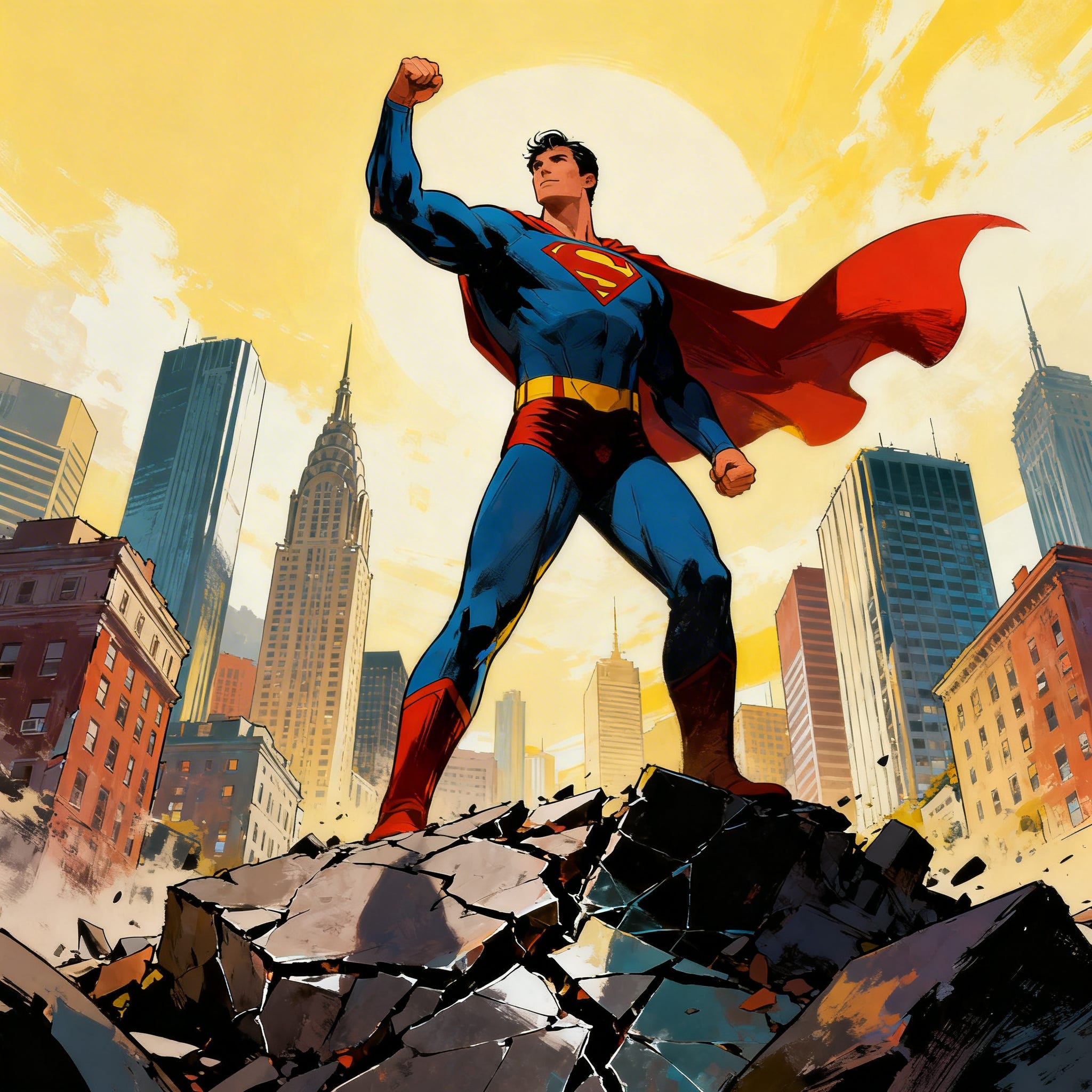
Superman doesn’t dominate people. He protects them.
He doesn’t isolate himself. He builds community.
And he refuses, stubbornly, almost annoyingly, to believe that cruelty is the inevitable state of the world.
Honestly, that kind of optimism might be the most radical position left.
Anyway.
If you made it this far through my rambling notes on Superman, thanks for sticking around. Really. I’m still figuring some of this out as I go.
Maybe next time we’ll talk about something else.
Or maybe I’ll accidentally become a Batman apologist.
Stranger things have happened.